How Long Does a Timing Belt Really Last in 2026? Most New Cars Don't Even Have One Anymore, but a 2026 Honda Pilot Still Needs Its Changed at 105,000 Miles
The timing belt is disappearing from new cars, but the few current models that still use one treat it as a fixed-mileage, non-negotiable replacement — miss it, and the repair bill can be ten times the cost of changing it on time.
A timing belt is a reinforced rubber belt that keeps a gasoline engine's crankshaft and camshaft turning in sync, so the valves open and close at exactly the right moment relative to the pistons. Unlike almost everything else on a modern car's maintenance schedule, it doesn't fail gradually with a warning noise or a dashboard light — rubber ages and eventually snaps, often with no notice at all. That makes the real answer to "how long does it last" less about driving habits and more about reading the one number that actually matters: the mileage and year interval the manufacturer set for your specific engine.
Most new cars don't have this problem anymore
The honest starting point for 2026 is that this maintenance item has mostly disappeared. Toyota and Lexus run a timing chain across nearly their entire current lineup, from the Corolla to the RAV4 and the hybrid Dynamic Force engines. Hyundai and Kia don't currently sell a single model with a timing belt — Elantra and Forte four-cylinders switched to chains years ago. Honda's own i-VTEC four-cylinders, including the current Civic and Accord, use chains too, with no scheduled replacement at all. A timing chain is metal, bathed in engine oil, and engineered to outlast the engine itself — it's one of the few maintenance items that simply went away as engines evolved.
Who else this affects in 2026
Beyond Honda's V6, the list of current mainstream US models still using a timing belt is short and getting shorter every year. The Hyundai Palisade and Kia Telluride — both common cross-shops for the Pilot — have run timing chains with no scheduled replacement for their entire production, as has the current Subaru WRX. Most of the models that still show up in generic "cars with timing belts" lists are older generations still common on the used market, or smaller-volume European models with turbocharged three- and four-cylinder engines, not anything currently new on a mainstream US dealer lot. In practice, for a 2026 model-year buyer the question has narrowed down to almost exactly one case: is the engine Honda's belt-driven 3.5L V6, or not.
Where the belt survives: Honda's 3.5L V6
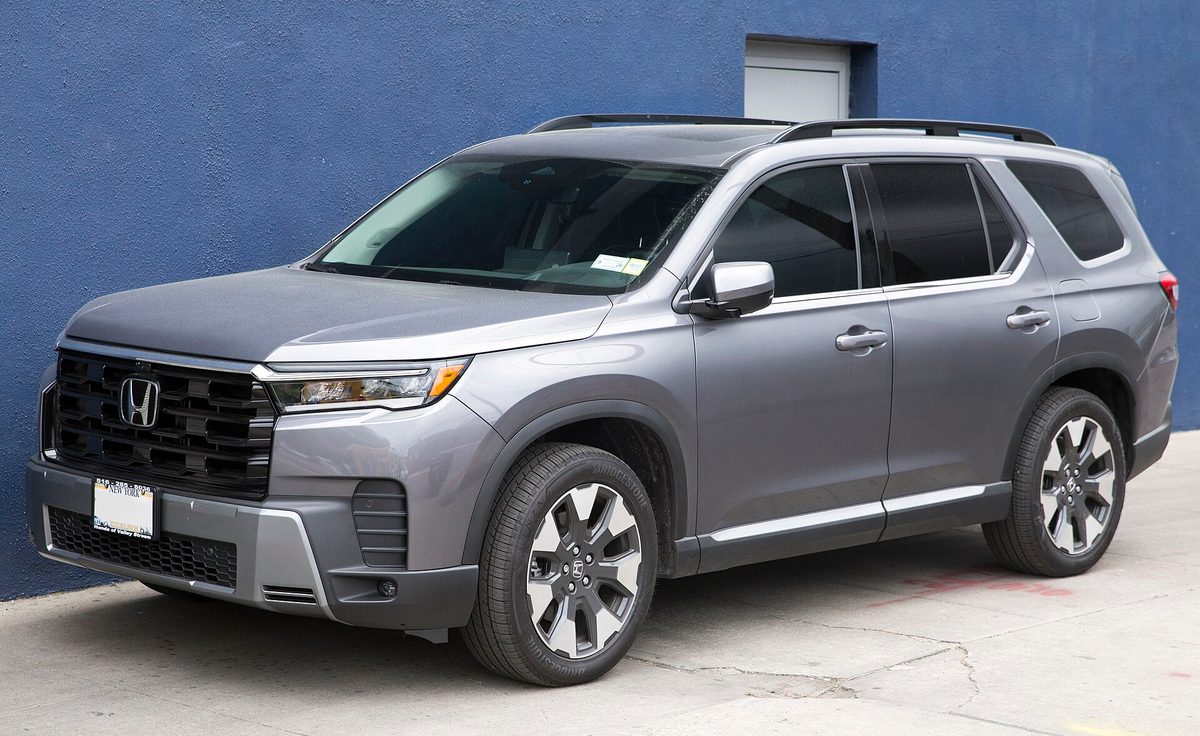
The clearest current exception sold in the US is Honda's own 3.5-liter V6, used in the 2026 Honda Pilot, Odyssey and Ridgeline. Unlike the four-cylinder engines in the same showroom, which switched to chains, "the Pilot's V6 utilizes a high-strength rubber timing belt," per Honda dealer service documentation, and Honda's Maintenance Minder system (Code 4) is set to call for that replacement between 100,000 and 105,000 miles. Severe driving conditions — short trips, extreme heat, heavy towing — can pull that interval down toward 60,000 miles. If you're cross-shopping a V6 Pilot against a four-cylinder CR-V or a Toyota Highlander's timing-chain V6, this is a real, recurring cost difference the window sticker doesn't mention anywhere.
Why the interval is both miles and years
A timing belt's replacement interval is always stated as two numbers — a mileage figure and a years figure — and whichever comes first is the real deadline. That's because rubber keeps degrading on a shelf, not just on the road: heat cycles, tension and exposure to engine vapors age the material even on a car that's barely driven. A low-mileage car that's 8 to 10 years old can need the belt replaced on age alone, well before it would hit the mileage number. If you're buying a used car with an unknown or undocumented timing-belt history, the belt's calendar age matters as much as the odometer reading.
What it costs to do on time
According to RepairPal's cost estimator, the average timing belt replacement across vehicles runs $918 to $1,338 — split roughly $603-$885 in labor and $315-$453 in parts — though the number swings hard by make and engine layout: RepairPal lists a Honda Civic at $456-$686 on the low end up to a Volkswagen Jetta at $1,322-$1,706 and a Ford F-150 at $2,273-$3,270 on the high end, largely driven by how much else has to come apart to reach the belt. RepairPal and most shops also recommend replacing the water pump, tensioner and idler pulleys in the same job, since they're already exposed and failure-prone on the same age cycle — skipping them to save money on one visit usually just buys a second labor bill in a year or two.
What it costs to skip
The number that makes the maintenance bill look small is what happens if the belt breaks instead. Most belt-driven engines, including Honda's 3.5L V6, are "interference engines": the valves and pistons physically share the same space at different points in the rotation. When the belt snaps and that timing is lost, the pistons slam into open valves, bending them and often cracking the piston or damaging the cylinder head in the process. Repairing bent valves alone typically runs $800 to $1,500 if the block survived intact; if the pistons or crankshaft took damage too, the repair becomes a rebuilt or replacement engine, commonly $2,500 to $5,000 and sometimes more. A $500-$1,200 preventative job turning into a $3,000-$7,000-plus repair bill is the entire argument for not pushing the interval.
The warning signs you usually won't get
A healthy timing belt doesn't announce its own decline the way, say, worn brake pads squeal before they damage a rotor. When problems do show up before a full break, they tend to be a ticking or slapping noise from the front of the engine as the belt loosens or a tooth starts to skip, visible cracking, fraying or glazing on the belt surface itself, or oil leaking from a front engine seal onto the belt, which degrades the rubber faster than normal wear. Harder starting and occasional misfires can show up too, if the belt has already started skipping teeth under load. The honest caveat: a meaningful number of timing belt failures give no warning at all — the belt simply lets go between one commute and the next — which is exactly why manufacturers specify a fixed mileage and age interval instead of leaving it to "wait until it sounds bad." Treat any of these symptoms as reason to have the belt inspected immediately, but treat their absence as proof of nothing.
Don't confuse it with the serpentine belt
A lot of confusion around this topic comes from mixing up two different belts. The serpentine (accessory drive) belt is usually visible from outside the engine, running the alternator, power steering pump and air conditioning compressor — it's a routine, relatively cheap inspection item that any shop checks at an oil change, and its failure strands you but doesn't destroy the engine. The timing belt is hidden behind a cover deep in the engine, is far more expensive to access and replace, and is the one where failure on an interference engine means real internal damage. If a mechanic mentions replacing "a belt" on your car, it's worth asking explicitly which one — the price difference alone is usually enough to tell them apart.
How to find your own car's real number
None of the ranges above substitute for your specific car's own number, because the interval is set per engine, not per brand — two different engines from the same manufacturer can carry two different intervals. The reliable source is your owner's manual or the manufacturer's official maintenance schedule, searchable by your exact trim and engine, not a generic make-and-model guide. If you bought the car used and the paperwork is incomplete, a shop can usually tell from the belt's physical condition and the VIN-decoded build date whether it's ever been done — worth the diagnostic fee before you assume a stranger's "it's fine" at face value.
The bottom line
For the overwhelming majority of new-car buyers in 2026, the timing belt is a non-issue — chains have quietly taken over almost the entire mainstream lineup, and that maintenance item simply isn't coming due. The exception that actually matters is narrow but real: anyone buying or already owning a V6 Honda Pilot, Odyssey or Ridgeline is on a fixed 100,000-to-105,000-mile clock that doesn't care how smooth the engine sounds, and anyone buying a used car with any belt-driven engine should treat the belt's documented service history as a real negotiating point, not a formality. It's a small, boring line item on paper, and the cheapest insurance against an expensive engine on the side of the road.
Related cars
Related articles
- 2026 Toyota RAV4 vs Honda CR-V Hybrid: Which Is Better? The RAV4 Wins on Price, Fuel and Warranty, the CR-V on Ride and Rear-Seat Room
- How Long Does an EV Battery Really Last? Real Data From 250 Million Miles Says Longer Than the Warranty Implies
- Honda Pilot vs Toyota Grand Highlander: Which Is Better? One Engine Option Against Three, and a Reliability Record That Isn't a Fair Fight Yet
- 2026 Toyota Highlander vs Honda Pilot: Which Is Better? The Last Highlander With an Engine Meets a Roomier Rival